

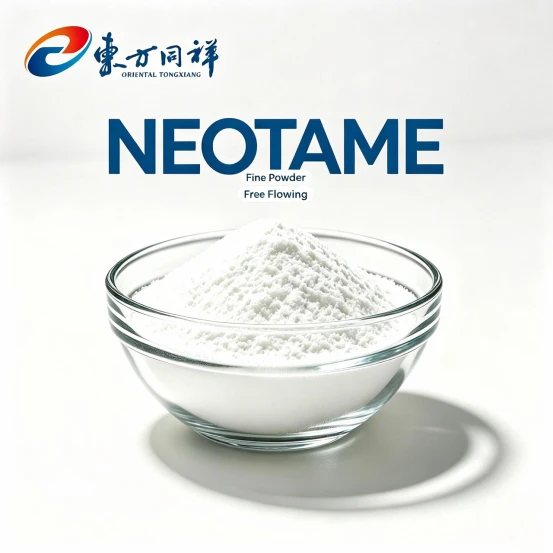
Neotame
Product: Neotame
CAS: No.165450-17-9
Molecular Formula: C20H30N2O5
HS Code: 2924299090
Appearance: White to off-white crystalline powder
Sweetness: Approx. 7,000–13,000 times sweetness as Sugar
Application: Food, Beverage, Dairy, Confectionery, Bakery & Tabletop Sweetener
1. Product Overview
Neotame is a high-intensity, zero-calorie sweetener derived from aspartame. Chemically it is N-[N-(3,3-dimethylbutyl)-L-α-aspartyl]-L-phenylalanine 1-methyl ester (C20H30N2O5). Its sweetness is approximately 7,000 to 13,000 times that of sucrose and 30 to 60 times that of aspartame, which means it is used at very low, parts-per-million-level doses.
Because the 3,3-dimethylbutyl group slows the breakdown of the molecule, neotame is more heat-stable and pH-stable than aspartame and contributes essentially no calories. It can be used on its own or blended with other sweeteners and bulking agents, making it a practical ingredient for sugar-free and reduced-sugar product lines.
We supply neotame in bulk for food and beverage producers. Each batch is released against the applicable specification with a COA and supporting technical documentation, and custom supply solutions can be discussed for specific sweetness, particle size, packaging or formulation requirements.
2. Development & Regulatory Approval
Neotame was developed by the NutraSweet Company in the 1990s as a next-generation sweetener built on aspartame chemistry. It has since received regulatory approval in major markets worldwide:
• United States - Approved by the U.S. Food and Drug Administration (FDA) on July 9, 2002 as a general-purpose sweetener for food and beverages (except in meat and poultry).
• European Union - Authorised as a sweetener and flavour enhancer (E 961) in 2010.
• China - Approved as a new food additive in 2003 (Ministry of Health Announcement No. 4 of 2003); its use is regulated under GB 2760 and its product quality under GB 29944-2013. It is designated INS 961 and CNS 19.019.
• International - The Joint FAO/WHO Expert Committee on Food Additives (JECFA) set an acceptable daily intake (ADI) of 2 mg/kg body weight per day. In 2025 the European Food Safety Authority re-evaluated neotame (E 961) and set an ADI of 10 mg/kg bw/day, concluding there is no safety concern at currently authorised uses.
3. Key Specifications
|
Parameter |
Specification |
|
Product Name |
Neotame |
|
CAS No. |
165450-17-9 |
|
Molecular Formula |
C20H30N2O5 |
|
HS Code |
2924299090 |
|
Product Standard |
GB 29944-2013 |
|
Appearance |
White to off-white crystalline powder |
|
Particle Size (Mesh) |
95% pass 100 mesh |
|
Identification |
Infrared absorption spectrum matches the reference standard |
|
Assay (dry basis) |
97.0–102.0% |
|
N-[N-(3,3-Dimethylbutyl)-α-Aspartyl]-L-Phenylalanine |
≤ 1.5% |
|
Water |
≤ 5.0% |
|
Specific Rotation (20℃, D) |
−40.0 to −43.3° |
|
Melting Point |
81–84℃ |
|
Related Substances |
≤ 2.0% |
|
Ignited Residue |
≤ 0.2% |
|
Residual Solvents |
Negative |
|
pH (5 g/L solution) |
5.0–7.0 |
|
Lead (Pb) |
≤ 1 mg/kg |
|
Total Aerobic Bacteria |
≤ 250 cfu/g |
|
Coliform |
≤ 10 MPN/g |
|
Fungi |
≤ 100 cfu/g |
|
Shigella |
Negative |
|
Salmonella |
Negative |
|
Staphylococcus aureus |
Negative |
|
Shelf Life |
24 months (minimum) |
|
Packaging |
25 kg/bag |
|
Storage |
Keep away from sunlight; store in a clean, odor-free, low-humidity environment |
Note: values follow the applicable product specification. Contact us for the latest COA, test method and destination-market documentation before purchase or product registration.
4. Physicochemical Properties
|
Property |
Value |
|
Appearance |
White to off-white crystalline powder |
|
Molecular Formula |
C20H30N2O5 |
|
Solubility in Water |
Sparingly soluble; about 12.6 g/L at 25℃ |
|
Solubility in Ethanol |
Very soluble (approx. 950 g/L) |
|
Melting Point |
81–84℃ |
|
pH (0.5% aqueous solution) |
5.0–7.0 |
|
Optimum pH Stability |
Most stable at pH 3.0–5.5 (optimum around 4.5) |
|
Heat Stability |
Withstands baking and pasteurisation; more heat-stable than aspartame |
|
Hygroscopicity |
Low; stable in dry storage |
5. Functional Benefits
• Extreme Sweetness Intensity - About 7,000 to 13,000 times sweeter than sucrose, so only tiny amounts are required to reach the target sweetness.
• Clean Sugar-Like Taste - Delivers a clean, sweet taste close to sucrose with minimal lingering aftertaste.
• Heat & pH Stability - More heat-stable and pH-stable than aspartame, and withstands baking and pasteurisation.
• Zero-Calorie Positioning - Contributes essentially no calories, supporting sugar-free, reduced-calorie and diabetic-friendly product positioning.
• Flavour Enhancement - Acts as a flavour enhancer, rounding out fruit flavours such as berry and citrus.
• Cost-Effective Sweetening - Its very low use level can lower the sweetening cost of the finished product.
• Flexible Blending - Works alone or in blends with other sweeteners and bulking agents to rebuild body and mouthfeel.
6. Application Selection Guide
|
Application |
Typical Use Level |
Contribution |
Formulation Notes |
|
Carbonated & still beverages |
0.001–0.01% |
Intense sweetness, clean taste |
Confirm pH and shelf-life; use alone or with other sweeteners |
|
RTD tea, coffee & juices |
0.001–0.01% |
Clean sweetness, flavour enhancement |
Adjust dosing; verify clarity and flavour balance |
|
Dairy & frozen desserts |
0.001–0.01% |
Sweetness with a clean profile |
Check protein stability, viscosity and heat treatment |
|
Confectionery & chewing gum |
0.001–0.01% |
Intense, heat-stable sweetness |
Combine with bulking agents for volume and texture |
|
Bakery & snacks |
0.001–0.01% |
Heat-stable sweetness |
Neotame does not brown like sucrose; adjust browning and moisture |
|
Tabletop sweeteners |
0.01–0.1% |
Intense sweetness in a small volume |
Blend with carriers for accurate, uniform dosing |
|
Pharmaceuticals & supplements |
0.001–0.01% |
Sweetness; masks bitterness |
Confirm excipient and active-ingredient compatibility |
Typical use levels are starting points for reference only. Please adjust them according to the formulation of your end product and confirm the applicable maximum use level and compliance for each destination market.
7. Stability & Formulation Guidance
Neotame is most stable in mildly acidic to neutral systems, with optimum stability around pH 4.5. It degrades faster in strongly acidic or alkaline conditions and at high temperature in aqueous solution, yet it remains more heat-stable than aspartame and survives typical pasteurisation and baking steps.
Because its use level is extremely low, accurate dosing and good dispersion are important. Pre-blending with a carrier or another sweetener helps achieve uniform distribution in dry mixes. Final sweetness and stability should always be confirmed in the finished product and against destination-market limits.
8. Quality Control & Batch Documentation
Each production batch is inspected against the applicable product specification (GB 29944-2013) before release. Batch-specific COA and related technical documents can be provided upon request, covering identity, assay, impurities, moisture, heavy-metal content and the microbiological limits listed in the specification. This supports downstream quality evaluation, production approval and destination-market documentation needs.
9. Packaging & Supply
Standard commercial packaging:
• 25 kg/bag with food-grade inner liner
Palletization, container loading and custom packaging can be arranged. For international B2B orders, please confirm the following with our team:
• MOQ - Minimum order quantity - subject to product form, packaging and destination; available on request
• Lead Time - Regular lead time - depends on stock availability, production schedule and order quantity
• Sample Policy - Samples available for evaluation and formulation testing, subject to availability and order requirements
• Payment & Trade Terms - Payment terms, trade terms and shipping port - to be confirmed based on the destination
10. Frequently Asked Questions
How sweet is neotame?
Neotame is approximately 7,000 to 13,000 times sweeter than sucrose and 30 to 60 times sweeter than aspartame, depending on the application. Only very small amounts are needed.
Is neotame suitable for baking?
Yes. Neotame is more heat-stable than aspartame and withstands typical baking and pasteurisation, so it suits bakery and other heat-processed products.
Can you provide a COA for each batch?
Yes. Batch-specific COA and related technical documents can be provided for qualified B2B buyers upon request.
What is the standard packaging and MOQ?
Standard packaging is 25 kg/bag. MOQ depends on product form, packaging and destination - please share your required quantity for a quotation.
Can samples be provided?
Yes. Samples are available for evaluation and formulation testing, subject to availability and order requirements.
What compliance documentation can you provide?
The product is manufactured to GB 29944-2013. COA, specification, allergen statement, GMO statement and destination-market documents are available on request.
How should neotame be stored, and what is the shelf life?
Store away from sunlight in a clean, odor-free, low-humidity environment. Shelf life is 24 months (minimum) under proper storage.
Is neotame suitable for sugar-free and diabetic-friendly products?
Yes. As a high-intensity, zero-calorie sweetener it is commonly used in sugar-free and reduced-sugar formulations. Regulatory status and applicable maximum use levels should be confirmed for each destination market.
Why choose neotame over aspartame?
Neotame offers higher sweetness intensity, better heat and pH stability, a clean taste and essentially no calories, and it can be used alone or blended to suit a target sweetness profile.
11. Request a Sample or Bulk Quotation
Looking for bulk neotame for beverages, dairy, confectionery, bakery or tabletop formulations?
Send us your target application and market. We can provide the product specification, COA, sample information, packaging details and a bulk quotation based on your requirements. We reply within 24 hours.
Please contact Oriental Tongxiang to discuss your neotame sourcing requirements.
Hot Tags: neotame cas 165450-17-9, China neotame cas 165450-17-9 manufacturers, suppliers, factory


