

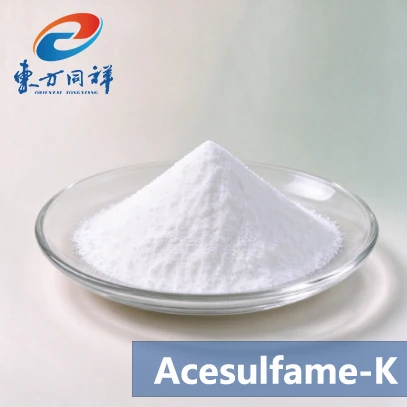
Product Overview
Acesulfame K, also known as Acesulfame Potassium, carries the EU additive code E950. It is approximately 200 times sweeter than sucrose. It boasts outstanding thermal and pH stability. It cannot be fermented by oral bacteria and thus does not contribute to tooth decay. Hardly metabolized in the human body, it contains nearly no calories and will not cause sharp fluctuations in blood glucose or insulin levels, making it suitable for diabetic consumers. It is widely used in sugar-free and low-sugar foods and beverages, as well as tabletop sweeteners, often formulated in blends with sucralose or aspartame. Oriental Tongxiang supplies premium-grade Acesulfame K with a range of particle size options.
Key Product Specifications
|
Parameter |
Specification |
|
|
Product Name |
Acesulfame-K | |
|
Molecular Formula |
C₁₂H₁₉Cl₃O₈ | |
|
CAS No. |
55589-62-3 | |
|
Raw Material |
Sulfamic Acid | |
|
Form |
30-100 Mesh, 100 Mesh |
|
|
Appearance |
White, odorless, free flowing crystalline powder, having an intensely sweet taste, approximately 200 times sweeter than sucrose(3% solution)
|
|
|
Assay (dried basis) |
99.0%‐101.0%
|
|
|
pH(1% solution) |
5.5‐7.5
|
|
|
Heavy metals (as Pb) |
5.0mg/kg Max
|
|
|
Arsenic |
3.0mg/kg Max
|
|
|
Lead |
1.0mg/kg Max
|
|
|
Selenium
|
10mg/kg Max
|
|
|
Total Plate
|
200cfu/g Max
|
|
|
Coliform
|
10cfu/g Max
|
|
|
Yeast and Mould
|
10cfu/g Max
|
|
|
Shelf Life
|
36months
|
|
|
Packaging |
25-kg cardboard drums with one or two PE liner bags, or otherwise agreed upon. |
|
|
Origin |
China |
|
|
Documentation |
COA / TDS available |
|
|
Application |
Sugar-free & low-sugar beverages, baked goods, dairy desserts, jelly, confectionery, chewing gum, tabletop sweetener blends, oral care and pharmaceutical products | |
Key Benefits of Aspartame
- Strong Synergistic Sweetening Boost
Oriental Tongxiang Acesulfame K provides around 200 times the sweetness of sugar. It amplifies sweetness power when blended with other sweeteners, lowering total dosage and controlling raw material expenditure for your bulk formulation.
- Broad Heat & PH Stability
This sweetener maintains steady sweetness across a wide pH range and survives high-temperature processing including baking, hot filling and retort sterilization. It avoids sweetness loss for shelf-stable beverage and confectionery recipes.
- Zero Calorie Label Friendly
It contains no available calories, fitting your low-sugar and sugar-free product roadmap. Oriental Tongxiang Acesulfame K supports clean label development for calorie-conscious end consumers.
- Low Hygroscopicity & Anti-Caking Performance
Our material features low moisture absorption. Free-flowing granules keep good flowability during long dry storage, preventing caking trouble in compound sweetener blending lines.
- Reliable Compliance & Full Document Support
We supply complete certification papers for customs and local market registration. Consistent batch quality helps you avoid production interruption and regulatory risks.
- Good Compatibility With Hydrocolloids & Dairy Base
It pairs well with pectin, carrageenan, protein and other common food ingredients. It will not disrupt gel forming or trigger precipitation in jelly, yogurt and plant-based dairy formulas.
- Flexible Bulk Supply & Mixed Container Option
Stable large-volume output matches your production schedule. You can combine this item with other sweeteners in one shipment to optimize sea freight budget.
Application Selection Guide
| Application | Typical Addition Level | Main Contribution | Key Formulation Consideration |
|---|---|---|---|
| Low-sugar / Zero-sugar carbonated drinks | 0.01–0.04% | Zero-calorie fast-onset sweetness, excellent synergistic sweetening effect, balance sour flavour | Control lingering sweet aftertaste, acidic shelf stability, blending ratio with sucralose / aspartame |
| Ready-to-drink functional beverages | 0.01–0.05% | Boost sweetness efficiency, mask bitter notes from functional raw materials, stable sweetness during hot filling | Wide pH adaptability, heat stability, match sweetness curve with other high intensity sweeteners |
| Pudding & jelly | 0.03–0.10% | Stable sweetness after gel formation, no interference with gelling system | Compatibility with pectin/carrageenan/gelatin, avoid affecting gel texture and elasticity |
| Sugar-free confectionery | 0.02–0.06% | Retain sweetness under candy boiling temperature, reduce sucrose dosage | Heating stability, flavour release control, suppress isolated sweet lingering taste |
| Chewing gum | 0.05–0.12% | Quick sweet hit, coordinate with mint/fruit flavour, extend sweet perception | Low moisture system adaptability, match release speed of gum base flavour |
| Powdered drink mixes | 0.05–0.18% | Rapid sweetness perception, good dispersion during reconstitution | Low hygroscopicity, blending uniformity, anti-caking performance of powder system |
| Compound tabletop sweetener blends | 0.04–0.15% | Core synergist to improve overall taste profile, lower total sweetener cost | Proportion matching with sucralose/monk fruit extract, particle size consistency for dry mixing |
*All suggested dosages serve as a reference. The exact addition amount needs to be adjusted based on your real formulation and target taste profile.
Certifications & Compliance
Available certifications and compliance documentation may include:

Certification availability depends on the specific product grade and production batch. Please contact us for current certificates and compliance documents.
Packaging & Supply
Standard commercial packaging can include:
- Powder :25kg net carton, Super Sack package
- Bulk packaging options available upon request
We support multiple trade terms and payment methods for your selection.
Trade Terms: FOB, CFR, CIF, DAP, DDP
Payment Terms: T/T (Telegraphic Transfer), L/C at sight
The applicable logistics scheme varies from country to country.
We can recommend the most suitable shipping solution and offer flexible payment terms according to your specific requirements.
For repeat orders, supply planning can also be discussed according to the buyer's annual consumption and delivery schedule.
FAQ
Q1: What is the synergistic sweetening effect of Acesulfame K, and what are the classic blending ratios for formula development?
A: Oriental Tongxiang Acesulfame K delivers prominent synergistic gain when compounded with sucralose or aspartame. The most popular ratio is Ace-K : Sucralose = 1:1 for carbonated drinks. The combination lifts overall sweetness efficiency, cuts total addition dosage and optimizes the sweetness curve to mimic sucrose taste.
Q2: Can Acesulfame K withstand retort sterilization and continuous baking cycles without sweetness loss?
A: Yes. It maintains stable sweetness under high temperature up to 225℃. It is suitable for hot-fill beverages, retort jelly, low-sugar baked pastries and shelf-stable condiments, which is a key advantage compared with heat-sensitive sweeteners.
Q3: Will the potassium content in Acesulfame K impact my finished food label or low-potassium functional products?
A: Acesulfame K contains potassium ions, but the residual potassium level is extremely low under normal recommended dosage. For special low-potassium functional formulas, we suggest you calculate the total potassium intake and test finished product before mass production.
Q4: How is the hygroscopicity of your Acesulfame K granules? Will it cake during long-term dry blending storage?
A: Our Acesulfame K features low hygroscopicity. The free-flowing granule grade resists caking better than many other high intensity sweeteners, which brings stable feeding performance for tabletop sweetener blends and powdered drink mixes.
Q5: Is Acesulfame K compatible with gelling agents such as gelatin, pectin and carrageenan for jelly and pudding?
A: It shows good compatibility with common hydrocolloids. It will not interfere with gel formation or change gel texture, making it a preferred sweetener for zero-sugar jelly, pudding and gummy candy formulas.
Q6: Does Acesulfame K have an E number? What specification standards do your batches comply with for India import?
A: Its E number is E950. Our Acesulfame K meets FCC and JECFA specifications. Full supporting documents including COA are provided for customs clearance. You need to confirm FSSAI category-wise usage limits before launching finished products.
Q7: Can Acesulfame K be applied in acidic fermented beverages and neutral dairy formulas?
A: It works steadily across pH 2.0–10.0. It adapts to acidic carbonated drinks as well as neutral yogurt and plant-based dairy, with no obvious hydrolysis during product shelf life.
Q8: When formulating compound sweeteners, can Acesulfame K reduce my overall raw material cost?
A: Yes. Thanks to its strong synergistic effect, you can reduce the addition level of other expensive sweeteners. It is widely adopted in cost-effective zero-sugar compound sweetener recipes for bulk production.
Q9: What differences between powder grade and granule grade Acesulfame K for my production line selection?
A: Fine powder dissolves quickly for liquid beverage and sauce systems. Free-flowing granules have superior anti-caking property, designed for dry mixing process in compound sweetener factories. Custom mesh size is available upon request.
Request a Monk Fruit Extract Sample or Bulk Monk Fruit Extract Quotation
Send us your requirements, Our team can provide the relevant product specification, COA, sample information, packaging details and bulk quotation based on your requirements.
Contact us to discuss your sourcing requirements.
Hot Tags: acesulfame-k cas 55589-62-3, China acesulfame-k cas 55589-62-3 manufacturers, suppliers, factory


