

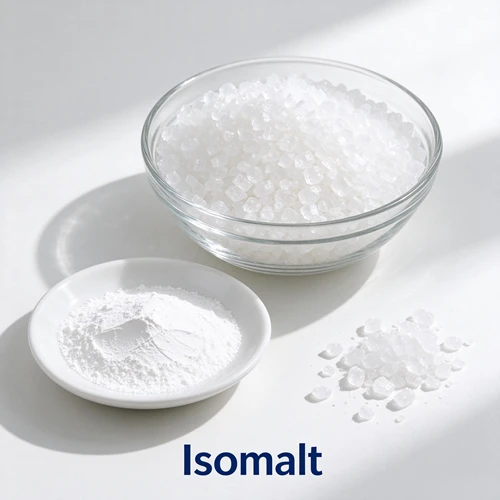
Product Overview
Produced via a catalytic hydrogenation process, Isomalt typically appears as white granules or powder.Its sweetness is approximately 40–60% that of sucrose, and it offers advantages such as high purity, low hygroscopicity, high stability, low caloric content, no impact on blood sugar levels, and non-cariogenic properties
Key Product Specifications
|
Parameter |
Specification |
|
Product Name |
Isomalt |
|
CAS No. |
64519-82-0 |
|
Molecular Formula |
C₁₂H₂₄O₁₁ |
|
Molecular Weight |
344.31g/mol |
|
Particle Size |
4-20mesh,80mesh,DC-Isomalt |
|
Appearance |
White granules or powder |
|
GPS+GPM-Content(on dry basis) |
97.0-102.0 |
|
D-mannitol & D-sorbitol (on dry basis) |
≤2.0 |
|
Moisture |
≤7 |
|
Reducing sugars(as glucose) |
≤0.3 |
|
Ash content |
≤0.1 |
|
Arsenic |
≤0.5 |
|
Lead |
≤0.5 |
|
Nickel |
≤1.0 |
| Application | Hard candies, sugar-free or low-sugar foods. Baked goods, chocolate products. |
| Packaging |
Granular products are packaged in 25 kg bags; DC-grade products come in 20 kg bags. |
| Origin | China |
| Documentation |
COA / SPES/MSD/TDS available |
Typical values for reference only. Please contact Oriental Tongxiang for the applicable product specification, COA, test method, allergen statement, GMO statement, organic certificate, and regulatory documentation before purchase or product registration.
Key Benefits of Isomalt
Low-calorie and low-glycemic
It contains approximately half the calories of sucrose and has a very low glycemic index (GI); it does not cause sharp fluctuations in blood sugar or insulin levels, making it suitable for consumption by people with diabetes.
High stability and low hygroscopicity
It remains stable in high-temperature and acidic environments, does not undergo the Maillard reaction, and has extremely low hygroscopicity. These properties prevent food products made with it from becoming sticky due to moisture absorption, thereby helping to extend shelf life.
Non-cariogenic
Oral *Streptococcus mutans* bacteria cannot metabolize it to produce acid, so it does not cause tooth decay; it is commonly used in sugar-free chewing gum and children's confectionery.
High tolerance
Compared to other sugar alcohols, the human body tolerates it well; consuming a certain amount daily (e.g., 50 grams) typically does not cause significant gastrointestinal discomfort.
Clean, pure sweetness
Its sweetness is approximately 50%–60% that of sucrose, making it one of the sugar alcohols with a taste profile closest to sucrose, without any noticeable cooling sensation or unpleasant aftertaste.
Application Selection Guide
|
Application |
Use Level |
Contribution of Isomalt |
Formulation Notes |
|
Hard Candy |
Can be used alone or in combination with other polyols |
Extremely low hygroscopicity prevents sticking and cold flow; allows bulk packaging, reduces costs, and extends shelf life |
Lower solubility than sucrose; cooking requires higher temperature or vacuum; syrup has lower viscosity and needs longer cooling time |
|
Chewing Gum & Compressed Tablets |
Conventional dosage range |
Low solubility, crystalline form; slow and lasting sweetness release; no cooling sensation; fully reveals flavor |
Granular isomalt improves compressibility and chewiness; can be combined with mannitol or sorbitol for wet granulation |
|
Chocolate |
Blended with isomaltulose; the blend can account for 24–40% of total product weight |
Low negative heat of solution; pure taste comparable to sucrose; enhances heat resistance of chocolate |
Blending with isomaltulose (e.g., 1:1 to 1:2) enhances heat resistance; sensory attributes show no significant difference from traditional chocolate |
|
Bakery Products |
Can replace sucrose at a 1:1 ratio |
High-temperature stable; does not participate in Maillard reaction; products absorb less moisture; improves shelf life and texture |
Generally no need to change traditional recipes; if browning is too light, slightly increase baking temperature or add a small amount of fructose |
|
Breakfast Cereals / Nutrition Bars |
US GRAS permits ≤20% in breakfast cereals; EU allows use in "low-calorie" or "no added sugar" products |
Low hygroscopicity improves storage life and texture; can serve as a binder for cereal bars |
Low sweetness; often needs to be paired with high-intensity sweeteners (e.g., acesulfame K, sucralose); to avoid laxative warning labels, use level should be <10% |
|
Jelly / Gummy Confectionery |
Research concentrations range from 5% to 25%; 20% gives the best overall results |
Can form a sugar body; sweet taste with no aftertaste; higher levels increase moisture content and hardness |
Solubility is only half that of sucrose; may crystallize at high levels; can pair with fructose to compensate for insufficient sweetness and hygroscopicity |
The above formulas are for reference only. Please adjust them according to the formulas of your end products.
Certifications & Compliance
We can provide certifications such as Halal, Kosher, ISO, FSSC, and HACCP,etc. Please feel free to contact me if you are interested.
Packaging & Supply
Standard Packaging
Granular products are packaged in 25 kg bags; 4–20 mesh products are typically palletized at 900 kg per pallet; DC-grade products come in 20 kg bags.
Palletization and Container Loading
For international B2B orders, buyers should confirm:
MOQ: Please contact us and provide your required specifications, packaging, and port of destination.
Delivery time: Depends on stock availability, production schedule, certification
Loading method:
For the 4–20 mesh grade, the standard is 900 kg per pallet; a 20-foot container (small container) can hold 18 tonnes when palletized.
For the 80-mesh product, the standard is 16 tonnes per 20-foot container (palletized).
The DC grade comes in 20 kg bags, with a load of 10 tonnes per 20-foot container (palletized).
Sample Policy:Samples available for evaluation and formulation testing,We can supply the quantity you require.
Trade Terms:Depends on customer requirements.
Shelf Life:The shelf life is 24 months in closed container. Suggest using it up within in one time after opened.
Storage requirements:store in a cool, dry, clean place
For repeat orders, supply planning can also be discussed according to the buyer's annual consumption and delivery schedule.
FAQ
Q: What are the specifications for Isomal?
A: The most commonly used mesh size is 4-20mesh,80mesh and DC-Isomalt.
Q: What is the shelf life of Isomalt?
A: 24 months if stored under recommended storage conditions.
Q: Does it cause cavities?
A: It is suitable. Isomalt has a very low glycemic index and does not significantly affect plasma glucose or insulin levels. Approximately half of it is digested and absorbed in the small intestine, while the remainder passes into the large intestine, where it is utilized by the gut microbiota.
Q: Is it suitable for people with diabetes?
A: It is suitable. Isomalt has a very low glycemic index and does not significantly affect plasma glucose or insulin levels. Approximately half of it is digested and absorbed in the small intestine, while the remainder passes into the large intestine, where it is utilized by the gut microbiota.
Q: What is the sweetness level?
A: The sweetness is approximately 45–65% that of sucrose.
Q: Can isomalt be used for making compressed tablets?
A: Yes, there is a specific direct-compression (DC) grade of isomalt designed specifically for tablet compression.
Request a Isomalt Sample or Bulk Quotation
Looking for bulk Isomalt for Candy, beverages, and various food products manufacturing?
Send us your requirements, Oriental Tongxiang can provide the relevant product specification, COA, sample information, packaging details and bulk quotation based on your requirements.
Hot Tags: isomalt cas 64519-82-0, China isomalt cas 64519-82-0 manufacturers, suppliers, factory


