
Stevia Extract
Why Choose Us?
Rich Experience
Qingdao Oriental Tongxiang International is located in Qingdao, China, founded in 1999. Life Bridge International Corp. was developed in California on July 26, 2010, as an extension of Oriental Tongxiang.
Complete Range of Products
We specialize in a wide array of products ranging from food Ingredients, Nutritional Ingredients, APIs, Vitamins to Veterinary products.
High Quality
Our commitment to quality service can be noted with our compliance to regulatory mandates such as GMP,FDA, and certifications such as ISO, Halal, Kosher etc.
Professional Team
Oriental Tongxiang has a "one team" mindset and philosophy in its operations that ensures all team members are focused on providing our customers with the highest quality and lowest cost products.
-
![Stevia Reb-A %97]()
-
![Sugar Free Sweetener Stevia Extract]() Sugar Free Sweetener Stevia ExtractStevia extract comes from the Steiva leaf(plant) 100% natural, NON GMO, ORGANIC.read more
Sugar Free Sweetener Stevia ExtractStevia extract comes from the Steiva leaf(plant) 100% natural, NON GMO, ORGANIC.read more -
![Sugar Free Stevia]() Sugar Free SteviaSugar free Stevia is an enzymatically Treated Stevia, (also known as enzyme-modified steviol glycosides, enzymatically glycosylated stevioside ) we have developed, using the extract of Stevia...read more
Sugar Free SteviaSugar free Stevia is an enzymatically Treated Stevia, (also known as enzyme-modified steviol glycosides, enzymatically glycosylated stevioside ) we have developed, using the extract of Stevia...read more -
![Natural High Sweetness Sweeteners]() Natural High Sweetness SweetenersStevia RA series include Stevia RA98, Stevia RA97, Stevia RA95, Stevia RA90, and Stevia RA60 etc., the figure is higher ,the sweetness is higher and the taste is better.read more
Natural High Sweetness SweetenersStevia RA series include Stevia RA98, Stevia RA97, Stevia RA95, Stevia RA90, and Stevia RA60 etc., the figure is higher ,the sweetness is higher and the taste is better.read more -
![Stevia Extract RA Series]() Stevia Extract RA SeriesHigh-purity steviol glycosides derived from Stevia leaves.read more
Stevia Extract RA SeriesHigh-purity steviol glycosides derived from Stevia leaves.read more
Clean, sweet taste with no bitter aftertaste.
Ideal for sugar reduction in food and beverages.
Non-GMO, calorie-free, and... -
![Natural Sweetness-- Stevia RA Series]() Natural Sweetness-- Stevia RA SeriesStevia RA series include Stevia RA98, Stevia RA97, Stevia RA95, Stevia RA90, and Stevia RA60 etc., the figure is higher ,the sweetness is higher and the taste is better.read more
Natural Sweetness-- Stevia RA SeriesStevia RA series include Stevia RA98, Stevia RA97, Stevia RA95, Stevia RA90, and Stevia RA60 etc., the figure is higher ,the sweetness is higher and the taste is better.read more -
![Blends Of Sweeteners]() Blends Of SweetenersWe can provide you blends products in many ways.You may give us your fomula and we can send you samples that you want,if not,we can also work out the taste and sweetness you prefer or plan to...read more
Blends Of SweetenersWe can provide you blends products in many ways.You may give us your fomula and we can send you samples that you want,if not,we can also work out the taste and sweetness you prefer or plan to...read more -
![Organic Stevia Leaf Extract Powder]() Organic Stevia Leaf Extract PowderStevia is a herb from the Asteraceae to mention a new type of Refined stevia natural sweetener. It has high sweetness, low-heat can be characterized by its sweetness is 200-300 timesread more
Organic Stevia Leaf Extract PowderStevia is a herb from the Asteraceae to mention a new type of Refined stevia natural sweetener. It has high sweetness, low-heat can be characterized by its sweetness is 200-300 timesread more -
![Organic Stevia Leaf Extract]() Organic Stevia Leaf ExtractOrganic Stevia Sugar Stevia Leaf Extract Stevia is a herb from the Asteraceae to mention a new type of Refined stevia natural sweetener. It has high sweetness, low-heat can be characterized by its...read more
Organic Stevia Leaf ExtractOrganic Stevia Sugar Stevia Leaf Extract Stevia is a herb from the Asteraceae to mention a new type of Refined stevia natural sweetener. It has high sweetness, low-heat can be characterized by its...read more -
![Organic Stevia Extract(STV)]() Organic Stevia Extract(STV)Stevia STV series include Stevia STV95,Stevia STV90, Stevia STV85etc., higher figure with higher sweetness and better taste.read more
Organic Stevia Extract(STV)Stevia STV series include Stevia STV95,Stevia STV90, Stevia STV85etc., higher figure with higher sweetness and better taste.read more -
![Enzymatic Modification Stevia Extract EM80/90/95)]() Enzymatic Modification Stevia Extract EM80/90/95)Enzymatic modification Stevia series includes Stevia EM80, EM90, EM95, higher figure means higher sweetness and better taste.Enzymatic modification stevia is refer to be added glucose during...read more
Enzymatic Modification Stevia Extract EM80/90/95)Enzymatic modification Stevia series includes Stevia EM80, EM90, EM95, higher figure means higher sweetness and better taste.Enzymatic modification stevia is refer to be added glucose during...read more -
![Natural Steviol Glycosides]() Natural Steviol GlycosidesNatural zero-calorie sweetener. Ideal for sugar reduction in food and beverages. High sweetness, clean taste. Available in conventional and organic grades. Customizable specifications for...read more
Natural Steviol GlycosidesNatural zero-calorie sweetener. Ideal for sugar reduction in food and beverages. High sweetness, clean taste. Available in conventional and organic grades. Customizable specifications for...read more


Stevia is an herbal plant that belongs to the asteraceae family, which means it's closely related to ragweed, chrysanthemums and marigolds. Although there are over 200 species, stevia rebaudiana bertoni is the most prized variety and the cultivar used for production of most edible products.
Stevia extract can naturally add sweetness to recipes even without contributing calories. Stevia extract leaf extract is about 200 times sweeter than sugar, depending on the specific compound discussed, which means that you only need a tiny bit at a time to sweeten your morning tea or next batch of healthy baked goods.
Many raw/crude stevia or minimally processed stevia products contain both types of compounds, whereas more highly processed forms only contain the rebaudiosides, which is the sweetest part of the leaf.
Is Stevia Extract Good for You
Pure stevia extract has been found to have no effect on blood glucose levels (and may even improve the ability of the body to metabolise glucose). Studies attempting to illustrate stevia's ability to improve insulin sensitivity and benefit diabetes are showing some promise.
Pure stevia extract has a bitter aftertaste, and for this reason many stevia-based sweeteners are blended with other sugars or artificial sweeteners to improve their taste. By blending them with other sweetening ingredients such as dextrose, maltodextrin and sucrose, some stevia products are capable of raising blood glucose levels. It is therefore important to read labels on products that use stevia.
Other research suggests stevia may be useful in the treatment of hypertension and management of type-2 diabetes, and it's also recognised for its anti-inflammatory properties and potential benefits for gut health. When not blended with other sweeteners, stevia contains no calories, so it can be beneficial for weight loss and for those looking for an alternative to sugar.
Stevia Extract Health Benefits
Stevia extract is natural, unlike other sugar substitutes. In south America and Asia, people have been using stevia extract leaves to sweeten drinks like tea for many years.
Stevia extract can also be helpful for:
● Diabetes. If you have diabetes, stevia extract can be a way to sweeten your yogurt or hot tea without adding carbohydrates and to maintain healthy blood sugar levels. But, some artificial sweeteners may not be as helpful if used in large amounts. We need more research on the benefits of stevia extract for diabetes.
● A healthy weight management program. It may help you lose weight and lower your risk of obesity and related health conditions. But some studies have shown weight gain due to how the brain reacts to sweetness with signs to eat more. More studies are needed to confirm weight loss benefits.
● A low-calorie or ketogenic diet. Stevia extract can be a good substitute for sugar because it only adds a few or no calories to your diet.
How Stevia Extract Is Produced from Stevia Leaf
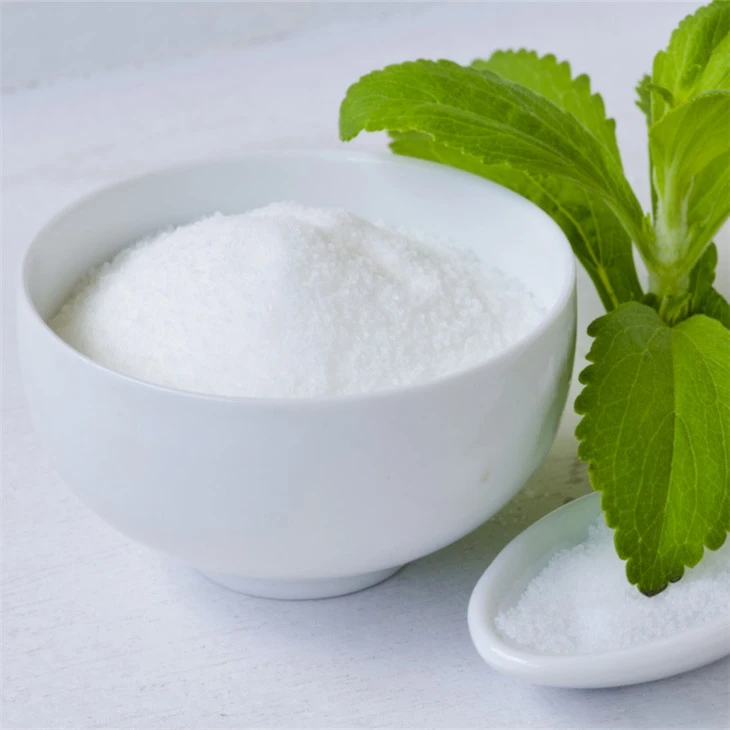


The plant Stevia rebaudiana, often called just stevia, has in its leaves substances that are intensely sweet. These so-called steviol glycosides are extracted and can be used as sweeteners in most foods and beverages.
Dried stevia leaves
- Stevia is grown in subtropical climate around the world for its sweet leaves. It is the leaves that are harvested. Dried, they are thirty times sweeter than regular sugar.
- The sweetness comes from substances called steviol glycosides. They are named so because they consist of a steviol moiety with several glucose moieties bound to it.
- The most common steviol glycoside is called stevioside. They make up between five and ten percent of the dry weight of stevia leaves. The next most common is Rebaudioside A (often abbreviated Reb A), which represents two to five percent of the stevia leaves' dry weight. Among those that are least are Rebaudioside M (or shorter Reb M).
Extraction
- The extraction begins with the leaves being allowed to steep in hot water. Much like when you brew a cup of tea – though on a larger scale. After a time, the stevia leaves are removed and the 'tea' is purified in several steps.
- The purified 'tea' then passes an ion exchange chromatograph. It is a tube containing a porous material that captures with electrical charge the steviol glycosides of the decoction and allows the rest to pass through. It can be likened to a sieve, where the substance one want to get hold of cannot pass while the rest is flushed away.
- Now, the coveted steviol glycosides are trapped in the sieve. To access them, the sieve is rinsed with pure alcohol. Then the electric charge releases the grip on the steviol glycosides and they are rinsed with the alcohol.
- The next step will be to remove the alcohol. Much can be separated by a membrane filter, but the remaining alcohol be removed by distillation.
- To remove the yellow color cast of the syrup, it is passed through activated carbon. Thereafter it is pressed to squeeze out a steviol glycoside solution which is filtered one last time to remove small residual particles.
- The steviol glycoside solution is then sprayed under high pressure into a tank filled with hot air. When the finely divided droplets meet the hot air, the very last of the fluid evaporates and crystals of steviol glycosides fall like snow.
Primary extract
- The snow of steviol glycosides is called primary extract. It consists of all the various steviol glycosides found naturally in stevia. How much there is of each depends on the raw material – the dried stevia leaves.
- The leaves contain mostly stevioside, which has a rather bitter taste and a palpable metallic aftertaste. A much nicer flavor is offered by Reb A. And best in class is Reb M, which is does not at all have a bitter or metallic falvour, but tastes almost like sugar (except it is up to 350 times sweeter).
- The amount of each of the steviol glycosides depends on a lot of things. There are, for example, refined stevia that gives much more Reb A than other varieties. And the amount of heat and sun determines how much of the sweet substances have been formed.
- In other words, the raw material varies widely, and with it varies the sweetness and taste of the primary extract. This makes it difficult to use it in food production, as the result would vary from batch to batch in that case.
- For these reasons, the primary extract needs to be further refined before it reaches you who develops and produces food or beverage.
Refining
- In the last step, steviol glycosides are separated. This is done through repeated recrystallization.
- The stevia extract is dissolved in alcohol. The solution is heated so that it evaporates. The vapor is led into a tube or tower, called a distillation column, to slowly cool down to a point where crystals begin to form.
- The first time this occurs, it is mainly crystals of stevioside that are formed. These are filtered from the solution and taken care of.
- The rest of the solution is heated again and the vapour is once more led into the distillation column. The second time, it is mainly crystals of Reb A that are formed. These too are filtered from the solution and taken care of.
- The distillation can thus be repeated a third time to obtain mainly Reb C. A fourth time to obtain mainly Dulcoside A. And so on.

● Stevia is primarily grown in Brazil, Paraguay, Japan, and China.
● The natural sweetener tastes 200 to 300 times sweeter than table sugar.
● Stevia extract can be classified as "zero-calorie," because the calories per serving are so low.
● It has shown potential health benefits as a healthful sugar alternative for people with diabetes.
● Stevia extract and erythritol that have been approved and do not appear to pose any health risks when used in moderation.
The form of stevia found in today's foods and beverages is generally high-purity stevia leaf extract, which is a purified form of stevia extract that has been evaluated and approved by major regulatory agencies around the world. Purified stevia leaf extracts can contain one steviol glycoside or several different glycosides. High-purity stevia leaf extract is a versatile sweetening ingredient for foods and beverages and offers consumers and food and beverage manufacturers a great option for natural-origin sweetness without the calories.
Crude stevia extracts and/or whole stevia plant leaves are sold as dietary supplements in some countries, but it is important to note that only high-purity stevia leaf extract has been evaluated and approved for use as an ingredient in foods and beverages by the world's major regulatory agencies.
More and more food and beverage companies are using stevia to help create great-tasting products with less sugar and fewer total calories. As a result, you may see a reduction in sugar and total calories per serving. On the ingredient label, stevia may be listed in different ways: stevia, stevia extract, rebaudioside A, Reb M, steviol glycosides and other variations depending on the country and the manufacturer. Stevia can be found in more than 40,000 foods and beverages around the globe today, including juices, waters, soft drinks, flavored milks, yogurts, baked goods, cereals, salad dressings, sauces, confections, tabletop sweeteners and more. The powerful combination of a zero-calorie sweetener with a plant-based origin makes stevia distinct in the food and beverage world.
Our Factory
Qingdao Oriental Tongxiang International is located in Qingdao, China, founded in 1999. We specialize in a wide array of products ranging from food Ingredients, Nutritional Ingredients, APIs, Vitamins to Veterinary products.
We have made it a serious point to prove the quality, effectiveness, and price of our ingredients. In fact, our commitment to quality service can be noted with our compliance to regulatory mandates such as GMP,FDA, and certifications such as ISO, Halal, Kosher etc. This commitment also extends to other areas of our company such as timely service and professional communication.
We look forward to working with you in providing excellent ingredients for your products. By doing so, we know that we will be contributing to the health of individuals and to the health initiative present around the world.


Our Team
Oriental Tongxiang has a "one team" mindset and philosophy in its operations that ensures all team members are focused on providing our customers with the highest quality and lowest cost products.


FAQ
As one of the leading stevia extract manufacturers and suppliers in China, we warmly welcome you to wholesale the best stevia extract from our factory. All our products are with high quality and competitive price.
Get A Quote
Oriental Tongxiang has a "one team" mindset and philosophy in its operations that ensures all team members are focused on providing our customers with the highest quality and lowest cost products.
-
Email
-
Location
Room 2803, Block A, China Resource Building, No.6 Shandong Road, Qingdao ,China